Friday, 29 May 2015

More learning about the aircraft of WW1

Rafael and Ivo brought model planes to show us today. We learnt that none of their models were used during World War 1. After looking at the symbols on the aircraft we worked out if they belonged to America, Germany or France. We will need to find out what symbol is in New Zealand's Air Force planes.


Today we learnt about German airships and how they were used over London during the war. We were intrigued by the massive aircraft and wanted to know what they were made out of. It was also interesting to find out that it took two years for the British to find a way to shoot down the airships.


 We finished off our little model planes then zoomed off to have a mock dogfight with each other!


Friday, 22 May 2015

Hearing about Wellington's War Exhibition

Mrs Howard took the Stepping Up session today. She showed us photos from her trip to see the War Exhibitions in Wellington. We were very interested to look at the pictures and hear the stories about them. 

Friday, 15 May 2015

Learning about WW1 aircraft

We are fascinated to watch a video about what dogfights are. When we first heard the word 'dogfight' we never thought it meant planes having a battle in the sky!


Here is one of the rules for a successful dogfight - secure the upper hand before attacking. We learnt that this means we should make sure our plane is in the better position before shooting them. It is also best to shoot an enemy plane from behind, in close range. This is so we don't waste ammunition. 


Watching pilots load bombs onto the racks underneath a plane was interesting! Some bombs were also placed inside the cockpit of the plane. The bombs looked funny because they had little wings on one end. Some bombs looked heavy with several people lifting them into position. Others seemed to be much lighter. 


We started to make a model World War 1 plane. We folded the parts together and glued the wings in place. Next week we will finish our project and fly our little planes!


Sharing with the group

Rafael was excited to show us the model plane he made with his dad. 


Bella worked out how long World War 1 was by punching in 1918, the year the war ended minus 1914, the year the war began. The answer she got was 4. 


Thursday, 14 May 2015

Aircraft of World War 1

We are exploring the aircraft used during World War 1. Click the links below to find more information.


Friday, 8 May 2015

Doug shares about his experiences as a peacekeeper

We learnt a lot today from Doug who is a retired Flight Seargent in the Air Force.


Doug told us about his experiences fixing helicopters for a combined Australia and New Zealand peacekeeping force in the Sinai Peninsular. He said that they were ANZACs, but not the original ANZACs. 

 Doug brought in his medals to show us which ones he earned while on peacekeeping duties. When Rafael looked at the medals closely he noticed that Doug's name and military number were engraved around the edges of the medals!


It was interesting for us to learn about helicopters! Doug showed us several pictures of helicopters that he used to fix. Peacekeeping helicopters are painted in contrast to choppers that are used in warfare. This is to make them distinctive in order that both sides of the conflict know they are neutral. We noticed from Doug's photos that the peacekeeping helicopters don't have doors! We also learnt that the sound that comes from the helicopters is not from the engine but rather from the spinning of the rotor blades which break the sound barrier!


We saw a photo of Doug when he was fixing a helicopter. He was wearing his Air Force uniform. We noticed that his rank was shown by the chevrons on his sleeve. Each rank has a different pattern. Doug said that the ranks in the military is similar to how schools are organised with beginning teachers, registered teachers, head teachers, deputy principals, and principals.


Here are the main points we learnt today:

Ivo - We learnt that Doug fixed helicopters in different countries. He was working in the Sinai desert.

Bella - Doug showed us his medals for being a peacekeeper. We got to hold the medals!

Aaron - Doug said that the helicopters were painted white so that everyone could see that it was a peacekeeping helicopter. War helicopters are painted with camouflage.

Lorin - Doug told us that a helicopter can shoot torpedos. If the torpedos hit something they would blow up. I think that we don't use torpedos anymore because they might blow up a floating city.

Joe - Doug told us about the chevron markings on his uniform. He had two. Chevrons tell us the rank. There are lots of ranks in the military.

Rafael - There are little names on the edges of medals. The name of the person that earned the medals is engraved there, along with their rank and military number. Every medal is for something different, for example, one of Doug's medals was for being a peacekeeper.

Tuesday, 5 May 2015

Rewarded for bravery

Lorin's family have recently discovered a special photo of their relative Lieutenant Colonal Victor Joseph Tanner, known as Joe, receiving a medal from General Freyburg for bravery. This happened in Italy during World War II.


Friday, 1 May 2015

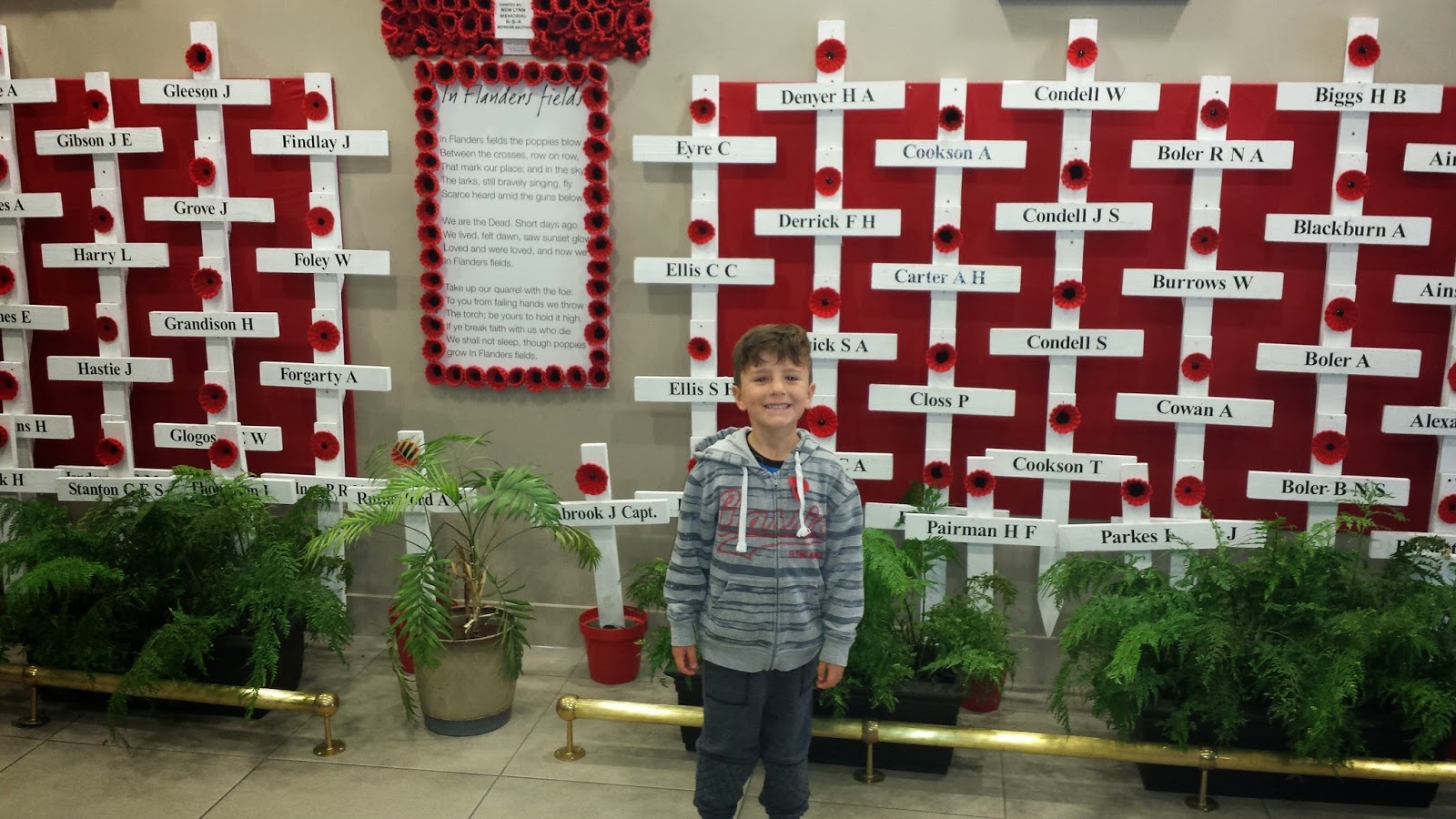
Uplifting the Field of Remembrance

We had a very special job to do today. It was to uplift the Field of Rembrance. We carefully lifted each cross out of the ground and stored them all away for the next remembrance event. 


Our Anzac Day Highlights

Bella went to a Dawn Anzac Service at a cemetery. She saw some soldiers with guns. The soldiers stood very still around the cenotaph and crowds and crowds of people gathered around it. She said, "I felt happy at the ceremony because I saw soldiers that had came back from war and young soldiers who are going to go to the war."

Ivo went to the Auckland Museum Dawn Parade and saw lots of soldiers. He told us, "There were Army, Navy and Air Force soldiers. There were helicopters that sounded like machine guns. There was bagpiping and The Last Post was played. When it was played the flags were lowered to half mast. It was really dark at the start when we arrived at 5:30pm. The museum had red lights shining on it. The sky started to get lighter. We sang the New Zealand national anthem and the Australian anthem too."

Aaron went to the New Lynn Anzac ceremony and saw some soldiers marching and some bands. He explained, "There were some soldiers on a truck with some army medals. There were people holding some flags. I saw some Australian flags and New Zealand flags. Anzac Day was special for me because there were soldiers that came back from the war and didn't die."

Rafael went to the Anzac parade in New Lynn. He got an ANZAC100 book. A young soldier gave it to him. He said, "I was sitting on my dad's shoulders when I was watching the Anzac parade. There was like this red truck which had seats on the back. People were sitting on it. There were loud bands that hurt my ears. It was nice and cool to watch the parade."

Lorin made some big posters showing the whole story of how the ANZACs went to Gallipoli. He explained the pictures to us. "Firstly the soldiers went to Egypt then they sailed to Gallipoli on a troopship. Hurt soldiers were lifted up onto the troopships by a special crane because they could not climb up the ladder."


Joe went with his family to a Glen Eden War Cemetery for the Anzac Service. He saw some flags. Some were from people who were not in the war. Some Scouts were holding flags. Some soldiers sang songs and everyone sang the national anthem in Maori and English. He explained, "We went to the RSA afterwards for morning tea. There were some real swords and guns up on the wall."


Thursday, 30 April 2015

The Grave of the NZ Unknown Warrior

The grave of New Zealand's unknown warrior is in Wellington.

Click the link here to find more information about it.

Anzac 2015

Here are some highlights of the Anzac Day Dawn Service at the Auckland Domain.

Timelapse video showing the evolution of 'The giant poppy'.

Field of Remembrance - Auckland Museum


Tuesday, 28 April 2015

Anzac Highlights


We commemorated Anzac Day by attending services to remember our brave ANZAC heroes.

Aaron, his friend and brother salute our ANZAC heroes.

Rafa, at the local RSA.


Friday, 24 April 2015

Highlights of our Stepping Up session

Today in our Stepping Up group we talked about Sergeant Richard Travis who earned the highest military honour, the Victoria Cross, for his bravery. He cut a wire box which was in no man's land, in broad daylight, then went back to his soldiers. Later on he fired on the Germans who were attacking his men. He overpowered them, capturing their weapons. 

We saw a photo of the Victoria Cross medal and also looked at the medals the Germans awarded their brave soldiers. They looked similar!

Our teacher gave each of us a special ANZAC coin to commemorate the 100th anniversary of the Gallipoli landings. 


When we watched a video about young soldiers who enlisted for war we heard about an English boy whose family didn't want him to go to war. He was so desperate to serve his country that he lied about his age and didn't tell his family that he was going to the war. He ran away but sadly, he never came home as he was killed in action on the Western Front. 

Saturday, 4 April 2015

Link to WW1 photographs

There are some interesting WW1 photographs at the link here .

Friday, 27 March 2015

The Anzac bond

We had a chat about the similarities and the differences between the Australian and the New Zealand flag. 


It was interesting for us to learn that the ANZACs played a cricket match at Anzac Cove to fool the Turks. We also learnt that there was a time in the 1950s when sports, entertainment and shopping were banned on Anzac Day. These days Australian and New Zealand sportsmen hold special sporting matches on Anzac Day based upon the bond of friendship begun at Gallipoli. 


Thursday, 26 March 2015

Commemorating the sacrifice of the ANZACs

Since the first Anzac commemoration in 1916, we remember the sacrifice of all our servicemen and women who have served our country, and particularly remember those who died during the Gallipoli campaign. Many people choose to attend Anzac Day services all around New Zealand and Australia. Some even travel to Turkey to take part in events held at Anzac Cove, the site of the Gallipoli landings.

Here is a video of the Anzac Day dawn service held at Anzac Cove, Turkey last year.


The Gallipoli campaign

Here is a video showing a reinactment of the landings of the ANZACs on 25 April 1915.


We found the video very interesting. It helped us realise how soldiers were killed or wounded. It must have been terrible if your friend was shot right in front of your eyes. 

We were also amazed at how noisy a war is. With guns firing constantly it sounded like popcorn popping, only much louder!

We watched the video below and were reminded that Germany, at the time, were trying to control the world while Britain and their allies fought to maintain freedom. 

Why New Zealand went to war...

We didn't get time to watch the videos below, but perhaps we can watch them at home with our families. 

What was the Anzac landing like?


What was it like on the front line at Gallipoli?

The Turkish push, and armistice


Since the Cricket World Cup is being held in Australia and New Zealand at the moment, it is the perfect time to discover how the ANZACs tricked the Turks by staging a cricket game while planning a secret evacuation of the penninsula.

Here are some Australian cricket players talking about the ANZACs.

The ANZACs were very clever in their ways of fooling the Turks at the time when they were really secretly evacuating the penninsula! We saw some photos of dummy soldiers and artillary that fascinated us. Click here to see them.


Friday, 20 March 2015

True or False

We thought about some statements and tried to decide if they were true or false. 


There are two statements we're not sure about yet. 


Le Quesnoy

We read an interesting story of how New Zealand soldiers liberated the French town of Le Quesnoy. 


We thought that the town looked beautiful before the war. The walls and moat around it made it look quaint. We could feel the pain of the French citizens who lived there during the war. When the New Zealand soldiers cleverly snuck up on the Germans holed up inside the town we felt relieved.